
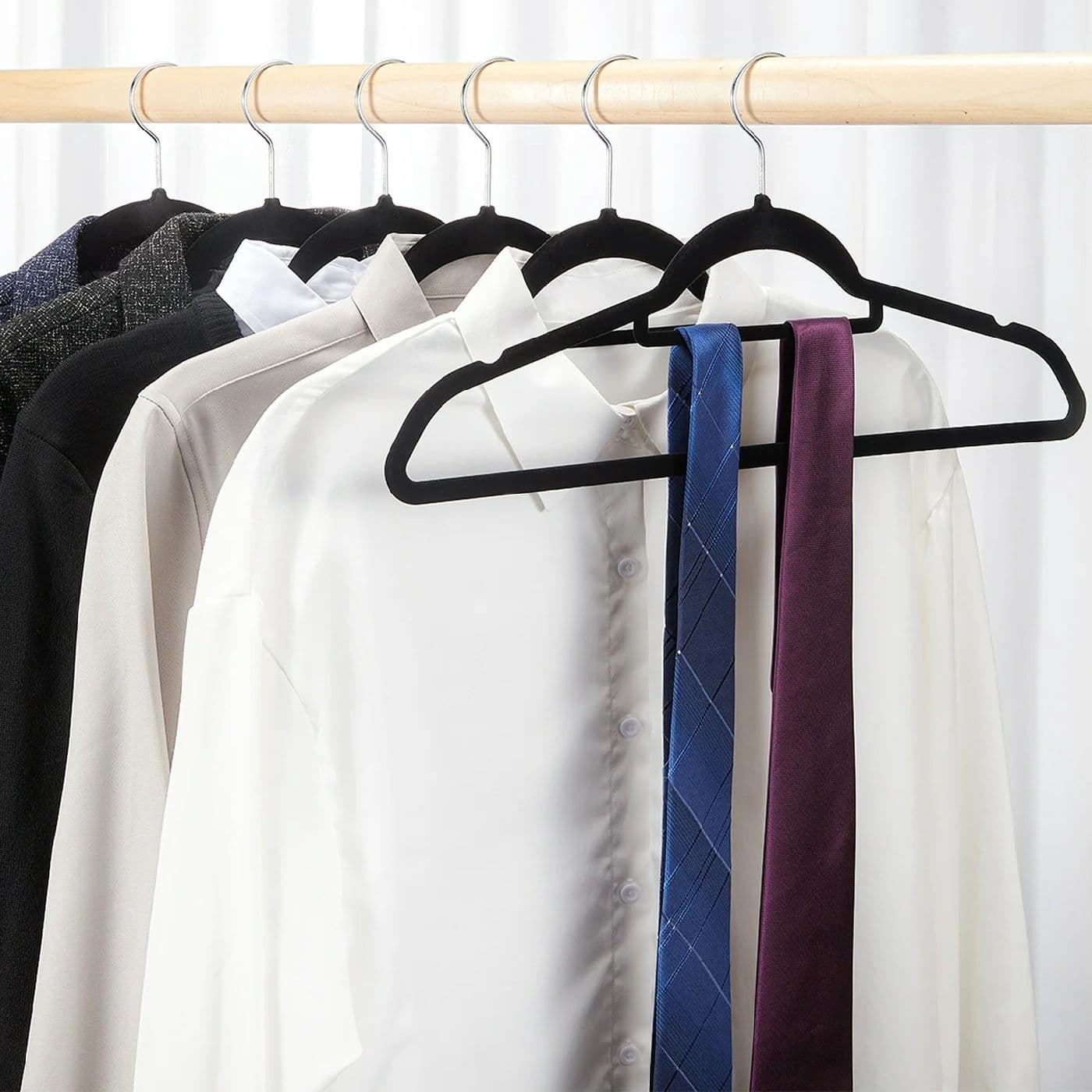
Almost everyone needs clothes, coat or suit hangers to use on a wardrobe hanging rail, freestanding rail, or bedroom and hallway hooks. However the amount of rail space you're likely to have will vary from house to house so it's important to learn about the thickness of different types of hangers (how many you can fit on a rail), and the different materials they're made from (which largely decides strength & what weight of garment is suitable for each type of hanger). This is what our article will hopefully summarise for you.
Should I Have All The Same Clothes Hangers?
The short answer is no! It's often seen as neat & tidy to have a rail full of matching hangers & more aesthetically pleasing when you open your wardrobe door. However using all the same hangers may result in fewer hangers fitting on your rail (if they're all relatively thick like a wooden hanger) and will also result in a big percentage of your clothes not being stored on the most suitable hanger which will usually result in unnecessary creasing, misshapen shoulders, and clothes frequently falling off hangers.
The Different Materials Used To Make Clothes Hangers
Probably the best known material for hangers and many people feel that they look the nicest. The benefits of wooden clothes hangers are firstly strength. The shoulder section can hold any weight of clothes, and if the hanger has a trouser bar with a strong join to the shoulder section then the bar will also hold a good weight of clothing without bending. Wooden coat hangers also tend to compliment wooden furniture well, perhaps in more period interiors, whilst painted wooden hangers can also look perfectly at home in contemporary interiors. Shaped wooden hangers are a timeless classic for tailored clothes and we would fully recommend them in almost every case if it's a jacket or coat shoulders you want to keep looking good. There's probably a place for some wooden hangers in every home, however because they take up more room this may be more when they can be seen as a feature (e.g. on coat racks & hooks or open rails) and it's worth considering hybrid hangers that combine wood with a second different material to achieve superior functionality. If you're interested in the properties of different woods then in brief bamboo is the most sustainable wood (grows faster therefore more plentiful), whilst conventional wood is slower growing and may be from forests that are best left alone, however it's still sustainable but probably worth trying to source used wooden hangers to reuse or upcycle by painting if you're interested and have the time. The other interesting type of wood is cedar and the main reason it's used for making clothes hangers is that it's scent naturally deters insects (e.g. moths). It's also often relatively fast growing (in managed forests), even where slow growing on average 3 new trees are planted for every tree felled (making new supply plentiful every year), it uses it's own scent to protect itself from pests so fewer cedar trees die before maturity, and it often grows in mixed forests so the other species of tree are often not cut down so the harvesting has impact on other trees, plants & animals. All these factors make cedar more sustainable and likely to be in good supply in the future without harming the surrounding environment because when a cedar tree gets cut down the rest of the forest that isn't cedar is usually just left alone.
Again very well known, and many of us may have only ever used plastic hangers because retailers often give us them free with a clothing purchase. Plastic hangers are also great for not discolouring or staining clothes, particularly if they're slightly damp (perhaps after ironing), being lighter in weight if they drop on your feet, and being available in a wide range of colours. Another advantage is that it's easy for manufacturers to add non slip properties (often a flocked velvet coating) & extra hooks and clips to plastic clothes hangers making them a versatile choice for a wide variety of garments hence why they're so widely used in retail. However most plastic coat hangers break easily, and few trouser bars made of plastic are effective due to bending. The other downside of plastic is the obvious sustainability & recycling issue. Some plastic may be able to be recycled but at time of writing most black plastic is still rarely recycled so most plastic hangers will be thrown out and many may just float round the world in the sea for eternity!
Probably linked in most people's minds to picking up dry cleaning with thin flimsy metal wire hanger, metal has come a long way since the birth of dry cleaning and does enable some strong features particularly for clipping clothes to keep them crease free. Metal is naturally strong (if not the bendy wire type) and also lends itself very well to coating either with paint or non slip rubber type finishes, as well as space saving dimensions to fit more on a rail. Metal production isn't a particularly natural or pleasant manufacturing process and the challenges of how much energy it uses to make, the increasing cost of energy, and the resulting impact on the environment may increasingly become a consideration with any metal product. However because metal components can be mixed with more sustainable wood consumers can now balance the credentials of wood and metal in the same hanger.
The Different Types Of Clothes Hangers
Skirt Hangers
Space Saving Hangers
Trouser Hangers
Suit & Coat Hangers
Non Slip Hangers